
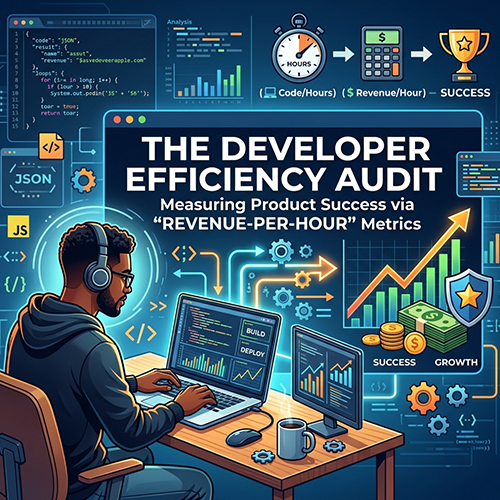
In the tech industry, technical proficiency is only the starting point. Writing clean code, mastering frameworks, and solving complex bugs can help you build a strong foundation in your early career.
However, long-term career growth requires a shift in mindset.
To truly accelerate your professional journey, you need to move beyond being a task executor and become a high-value strategic asset who understands not only how to build solutions, but also why those solutions matter.
Whether you are progressing through a corporate career path, creating independent projects, or aiming for senior engineering leadership, these strategies can help you maximize your career growth.
Align Your Technical Skills With Business Value
One of the biggest mistakes developers make is learning technologies without understanding their real-world purpose.
A programming language, framework, or tool only creates value when it helps solve meaningful business problems efficiently.
Understand the Business Impact
Learn how your product or company creates value and generates revenue.
Understanding key business metrics such as customer acquisition, retention, conversion rates, and performance improvements allows you to focus your engineering efforts on tasks that create measurable impact.
Speak the Language of Business
When proposing technical improvements, avoid explaining only the engineering problem.
Instead of saying:
“We need to refactor this module because the code is difficult to maintain.”
Explain the business impact:
“Refactoring this module will reduce deployment time, improve performance, and help the team deliver features faster.”
Build a T-Shaped Skill Profile
To stand out in the technology industry, aim to become a T-shaped professional.
This means developing deep expertise in one core technical area while also gaining a broader understanding of related fields.
Develop Deep Specialization
Become an expert in your chosen area, whether it is software architecture, performance optimization, frontend engineering, backend systems, cloud infrastructure, or data engineering.
Build expertise that makes you the person others rely on for solving complex problems.
Develop Broad Understanding
Expand your knowledge beyond coding.
Learn the basics of product management, user experience design, analytics, and marketing.
Understanding these areas helps you collaborate better, make smarter decisions, and build solutions that solve real user problems.
Fail Fast and Improve Through Rapid Prototyping
Career growth is strongly connected to your ability to experiment, learn, and adapt quickly.
The technology industry rewards developers who can validate ideas efficiently instead of spending months building solutions without testing their value.
Adopt the MVP Mindset
Apply the Minimum Viable Product approach to your work.
Create prototypes, test ideas, collect feedback, and improve based on real results before investing significant time into large solutions.
Learn From Data, Not Assumptions
Use analytics, user feedback, and performance data to guide your decisions.
The faster you can experiment, learn from failures, and improve, the more valuable your experience becomes.
Automate and Build Reusable Architecture
A junior developer solves a problem once.
A senior developer creates systems that prevent the same problem from happening repeatedly.
Optimize Your Workflow
Identify repetitive tasks in your daily routine, such as manual deployments, environment configuration, repetitive coding, or unnecessary processes.
Automate these tasks so you can focus your time on higher-value engineering work.
Think in Modular Systems
Build reusable components, libraries, utilities, and scalable architecture.
Creating reusable solutions reduces future development time and improves your productivity over the long term.
Own Your Professional Growth and Visibility
Hard work alone does not guarantee career advancement.
Visibility, communication, and the ability to demonstrate your impact are equally important.
Document Your Achievements
Maintain a record of your projects, technical challenges, and measurable results.
Examples:
Improved application performance by 25%.
Reduced system response time through optimization.
Delivered important features ahead of schedule.
These achievements help during performance reviews, interviews, and portfolio development.
Share Your Knowledge
Mentor junior developers, write technical documentation, share your experience, and contribute to your engineering community.
Teaching others strengthens your own understanding and helps establish you as a future leader.
The Bottom Line
Your career is your biggest long-term project.
Treat it like a product that requires continuous improvement.
Analyze your workflow, automate inefficiencies, measure your progress, and make sure every solution you build creates real value.
The developers who grow fastest are not only those who write better code — they are the ones who understand business problems, create meaningful impact, and continuously improve themselves.
What is one repetitive task in your current development workflow that you can automate or improve this week?